pathological preparation
musings on getting the first post out

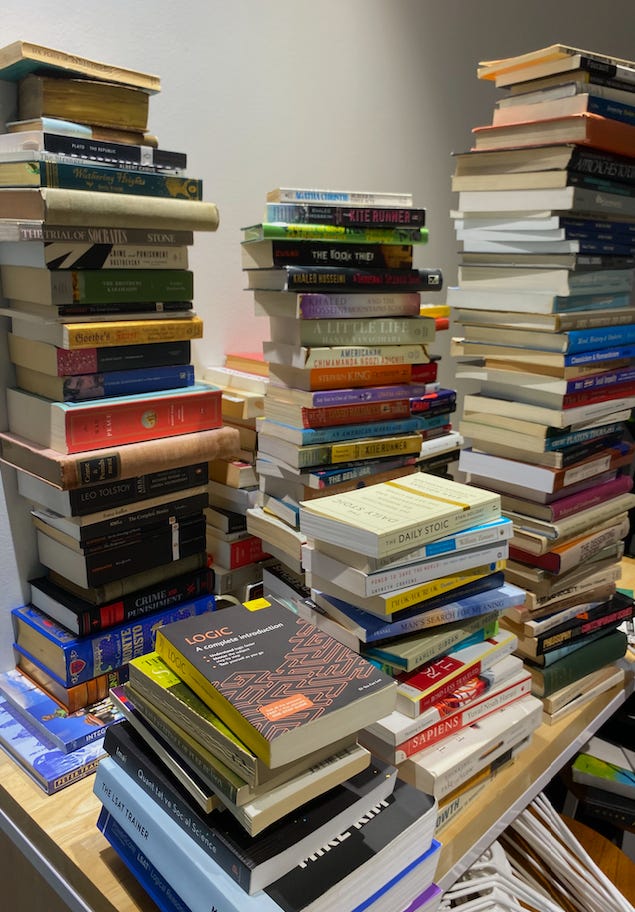
For as long as I can remember, I’ve been chasing an elusive ideal: perfectionism. I’m the kind of person who spends five hours on an email only to not send it. This post? It’s gone through multiple iterations, each abandoned for one of a million reasons I could find. Here’s the pattern I’ve noticed in myself:
Come up with a super cool, exciting idea.
Map out the plan of execution.
See it for what it really is.
Come up with more plans.
Let it fizzle out.
This cycle repeats endlessly, leaving behind a bunch of lists, docs, and notebooks full of ideas that never get realized.
But why does this happen? If it’s not already clear, the answer is perfectionism. I think it’s unfortunate that we often speak of perfectionism almost as if it’s a virtue—something that bears fruit for those who have it. It’s a cliché go-to in job interviews when asked, “What’s your greatest weakness?” If you still answer with perfectionism, you’d be better off finding a new answer. People are beginning to see it for what it is: cheap signaling disguised as vulnerability.
Even in writing this, I’m not sure I would’ve managed purely on willpower alone without the encouragement of friends and good examples to emulate. More than likely, I would have gone through the same cycle, abandoned it, and concluded that I’m just not the type of person who is driven or talented enough to follow through. Hopefully, some future version of me would be.
I think what’s really behind it is fear. Perfectionism is a mechanism to protect myself from feelings of inadequacy. An anecdote: I’ve wanted to start this for a while and proudly announced in a group chat with friends that I would complete it as a form of social accountability. Spoiler: I didn’t. They’re all people I admire, and I’ve noticed that we often do things—intentionally or not—so people will draw particular conclusions about us. What did I want them to think when I made the announcement? Probably that I was smart, interesting, and agentic—all the things I admire in them. But actually writing it—actually creating something—was different from what I expected, even though I’d been through the cycle before.
In preparation, I opened dozens of articles from writers I enjoy, calling it "research." But it wasn’t really preparation—it was perfectionism manifesting itself, protecting me from fears: that my ideas weren’t valuable or original, and that I wasn’t as good a writer as I thought. If you’ve struggled with perfectionism, maybe you relate to this. Maybe you don’t. But it feels good to finally let my thoughts flow onto this document, to examine how it manifests in my life.
The tricky part is that preparation often feels like progress, even though it’s just waiting. As long as I’m waiting, I don’t have to confront the reality.
And I wish I could say realizing all this has freed me from the cycle. If you’re anything like me, you probably fixate on how great things could have been if only you’d started earlier. I’ve recently managed to establish a fairly consistent gym routine, going 4-5 days a week. It’s a significant improvement in my life, yet I can’t help but feel disappointed. Last year, I had a similar streak for about three months before giving up for the entire academic year. Maybe you can relate to this in other areas of your life. It doesn’t matter much that I’ve made real progress—I still compare it to what could have been if only I had started earlier. That comparison is relentless.
The problem isn’t just the wasted time; it’s the invisible, unreachable bar we set for ourselves. A mixture of guilt, fear, dishonesty with ourselves, and the impossible standards we think we should meet but never do. And here lies the paralysis of perfectionism: it’s far more comfortable to live in the liminal space before production, where all you have is potential. “He reads a lot, so of course he’d be a great writer.” “She’s a 4.0 student, so of course she’s brilliant.” But we never put these assumptions to the test.
It’s theoretically more comfortable, at least for perfectionists, to live in that space of unrealized potential than to confront something more frightening. That behind all the markers and external symbols, my perception of myself might be wrong. Maybe I’m not as smart or capable as I thought. And maybe, deep down, I already believe that. It’s often easier to live in a place where you don’t have to confront that fear than to face it and realize you’re not who you thought you were. And in that place, all the things you once liked about yourself—your curiosity, creativity, and love for learning—are things you stop engaging with.
This is why I think I’m especially sensitive to naysayers—people who put down the goals and aspirations of others. I can’t imagine having to fight both your own inner critic and the opinions of those around you.
A good quote for this is, “Stop waiting for the perfect conditions to start. Starting is the perfect condition.” The belief that there’s such a thing as a perfect moment or perfect execution is pervasive. We spend years preparing for college acceptance. We talk about failed relationships as stepping stones to “the one.” But the perfect moment never comes.
I have other, probably more important things to do right now, and I could easily talk myself out of doing this, but... as Nike says, you just do it. What I know, and what anyone reading this probably knows, is that it’s better to embrace vulnerability and imperfection, fail quickly, iterate, and build momentum. Looking back, my proudest moments came from this approach—not from static perfection.
Even now, I wouldn’t have been able to write this on willpower alone if it weren’t for friends and role models. Without them, I would have abandoned this, concluded I wasn’t driven or talented enough, and hoped a future version of me would be.
In wrapping this up, I don’t know where the solution is. I’ve been lucky not to deal with naysayers, and I’ve been surrounded by amazing, encouraging people. I hope the same for you. I don’t have a neat solution to offer. Just gratitude for the support I’ve had, and I wish the same for you. If I had to though, #thinklessdomore."
YES!!! I hear you. Oh boy. Same challenge for me. My latest tactic, whether I’m working on an email, a craft project, whatever: aim for (what “I’d” consider as) 75-80% quality of work, and just put that darn thing out in the universe. I figure my 75-80% product is better than my zero %. Intentionally or not, plenty of people are producing stuff of 25% quality and somehow, amazingly, the world keeps turning. If you want to participate in a particular space, participate. We have to break free from the “110% perfect“ prison we keep ourselves in.