so, this might be the greatest city in the world
one month in San Francisco

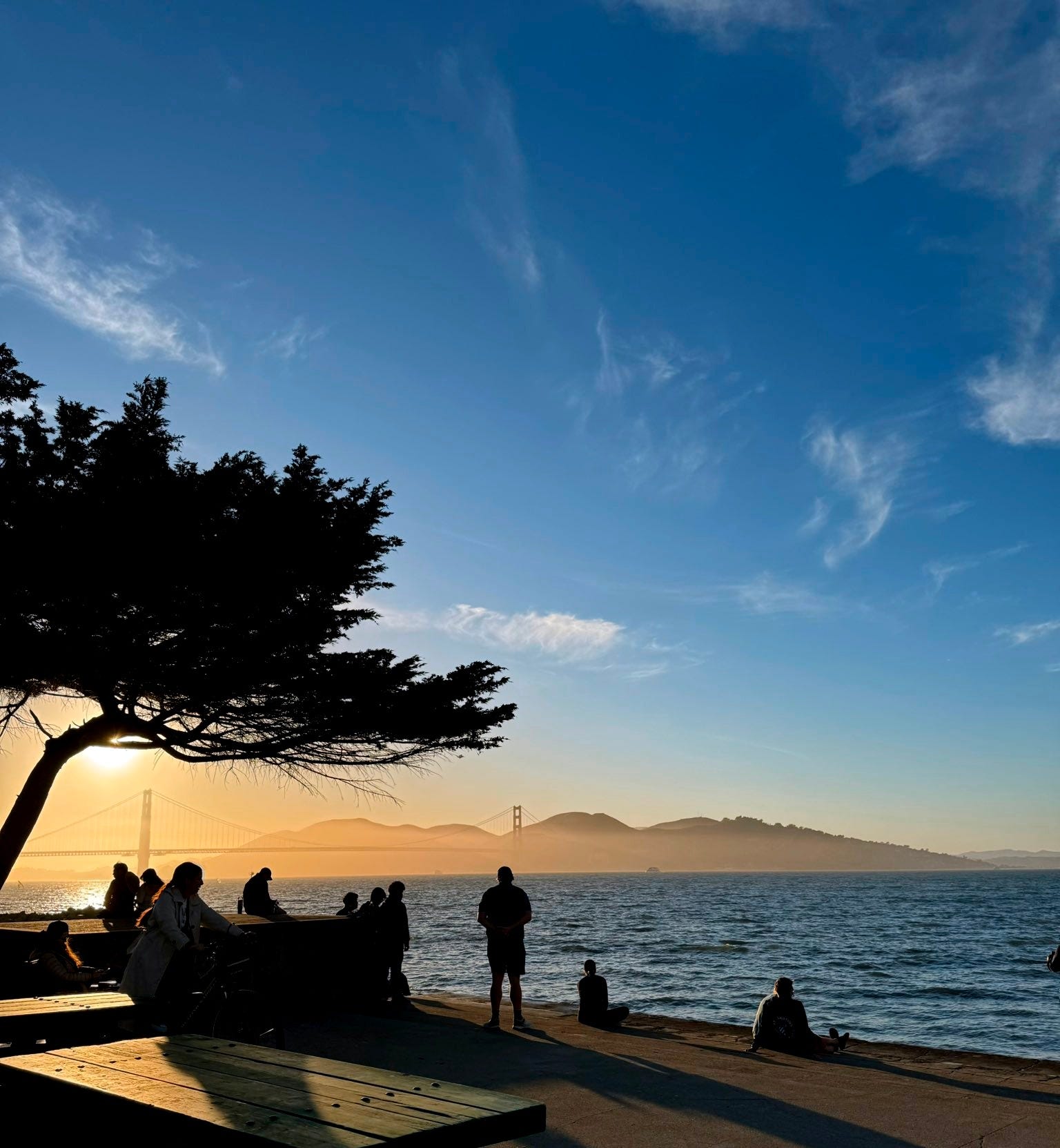
When I first landed in San Francisco, I had no idea what I was looking for. I came here about a month ago—unemployed, newly single, and, for the first time in a while, unanchored in any serious way. So I adopted a policy of “aggressive openness,” which sounds like a weird therapeutic intervention but is just a convoluted way of saying: I’ve been saying yes to everything.
In most cities, you can sense some kind of dominant social gravity. New York has ambition. LA has image and influence. Berlin has irony. San Francisco has…what?
At first, I thought it was optimism. People here say things like “it’s early days” or “this could be the unlock for consciousness research.” It sounded like a Silicon Valley cliche, until I realized they were seriously stating their intentions, the way medieval cathedral builders might’ve discussed projects they’d never see completed.
But optimism didn’t feel exactly right. It’s too emotional, too forward-looking. San Francisco doesn’t always believe things will get better. It believes things can get better–and the way to find out is to try out something that’s completely insane to see if it might work.
The central principle, as far as I can tell, is acceleration.
The native motion is the pivot. Everyone is always mid-experiment: on themselves, their companies, their bodies, their relationships, even their ethics. I’ve heard someone describe their personality as “in beta.” Everyone seems to be A/B testing their metaphysics.
In a place like Minneapolis, the great sin is being a narcissist. In San Francisco, the great sin is being unscalable.
I met a guy at a party about 96 hrs ago who said, “I’m working on sadness.” I asked him what this meant. He said, “I mean globally…like trying to reduce net sadness in the world…using software.” This didn’t feel cynical to me. It felt like someone who had learnt to think of themselves as an edge case in their own life.
This is maybe the defining feature of the city: the conversion of inwardness into infrastructure. It’s not uncommon to meet someone who raised a few million dollars to fix a problem they first encountered on a bad mushroom trip in 2017.
I can feel it in conversations. People don’t ask each other what they believe or where they’re from. They ask what they’re currently exploring. Belief is too static, too pre-committed. But exploration—that’s safe. That can be changed tomorrow…better yet, improved.
And yet, beneath this flexibility, I sense something remarkably stable. A structure to the city’s inner life. Everyone is looking for the same thing, though they wouldn’t phrase it this way. They’re looking for a way to be undefended.
There’s this lovely idea from Chris Olah; his take on micromorts: micro-marriages. (ACX take on it also good) Tiny probabilities that any given interaction might evolve into something amazing and meaningful i.e. love, collaboration, best friendship, world-altering education. Individually unlikely, but collectively inevitable if you show up enough.
Often, people think about this incorrectly. They focus on the individual probabilities, which are, in fact, tiny. The magic again isn’t in any one interaction, but the compounding effects of many interactions over time.
Cities work the same way, except instead of micro-marriages with other people, they offer you micro-marriages with possible versions of yourself.
Every conversation becomes a tiny probability that you’ll discover you’re the kind of person who could start a great company, write a book, organize a movement, or just think about things you didn’t know you were capable of. I mean this place is ruthlessly efficient at surfacing these in you.
In some video games, you get zone-specific stat boosts. +20 Charisma in the Elf Forest. +15 Strength near Volcano Forge. This definitely exists. I’ve never seen a good real-world theory of this, but I’ve definitely seen real-world versions. San Francisco is one. Not for everyone, and not forever. But if you happen to be a particular kind of slightly-too-online, overeducated, intellectually restless, socially experimental person? SF seems to offer a +25 to “What’s Possible” for your character. But that +25 boost doesn’t come cheap…literally or psychologically. The city filters. Aggressively.
Which raises the real question: what kind of sorting mechanism is a $4,500/month studio apartment?
It’s not just selecting for income. In fact, plenty of high earners bail the moment they realize they’re sharing a hallway with six polycules and a guy livestreaming his ketamine microdosing protocol. No, it’s selecting for something weirder. People who either:
(a) has such extreme time preference that future wealth justifies present material deprivation, or
(b) derives utility from proximity to information flows that most people literally cannot perceive.
I'm increasingly convinced it's mostly (b).
Walk through SoMa and you’ll overhear conversations about fine-tuning LLMs, vector embeddings, parameter slippage, quantization strategies. It’s not just that this would be incomprehensible at a dinner party in 99% of America. It’s that here, someone might interrupt with a disagreement about sampling temperature.
There’s an unusually high density of people thinking about genuinely important problems…not just “disrupting” laundry or meal prep. (Although yes, you will still hear someone arguing that their B2B SaaS dashboard for CFOs is going to revolutionize human flourishing. You learn to filter.)
And the people here? They're all odd in a very specific way. It’s easy to find people who:
won’t let you get away with a lazy explanation
take joy seriously
refer to their last five years of life as a “side quest”
ask what you’re building and what you’re healing from, in the same breath
The ecosystem reinforces itself. In most places, weird ideas have to pass through a filter of social proof before they reach you. Someone says they want to build a brain-computer interface to reduce global sadness, tells their normie friends, gets discouraged by silence and a raised eyebrow. Here, they mention it in a coffee shop and the person next to them says, “Oh, that’s like what my housemate tried…but she pivoted to neuroaesthetics. Want an intro?”
And so the idea survives long enough to become real.
Some interesting things I’ve seen/done that I attribute to SF:
Watched a friend pilot an actual flying car
Participated in taking over Angel Island for an island-wide zombie tag game
Tried to recruit Gwern to my house for a party game night after a 2 hr conversation about cat urine and the failure to predict scaling laws
Maintained a straight face at a dinner where someone casually said “I did MDMA with my therapist and now I can talk to my dad” and everyone nodded with academic seriousness
Preliminary Conclusions (Subject to Update)
Right now, I'm charmed by the earnestness. The way people say "changing the world" without detectable irony. The founder who told me, with tears in his eyes, about his mission to "democratize joy."
I suspect in 6 months I might find it tiring…the relentless optimism, the inability to have a conversation about weather without someone turning it into a startup idea. But right now, it's like watching children play with the concept of future, so serious about their games that they make them real.
I haven’t formulated my final assessment yet. I don’t know what kind of person I’m becoming. But I’m more curious than afraid right now. I've started ending conversations with "let's build something together," and yesterday I caught myself explaining to someone why their idea for edible packaging wasn't ambitious enough.
The city is teaching me its language. Whether that's inspiration or infection remains to be seen.
Somewhere in this city, someone is about to have an idea that will change everything.
Somewhere else, someone is realizing their everything-changing idea won't work.
Both feel equally sacred here.
This seems to be the most useful thing I’ve learned so far.
i am tired of the lack of human and art part of SF :(
loved