the art of letting go
within every hello, the seeds of a goodbye

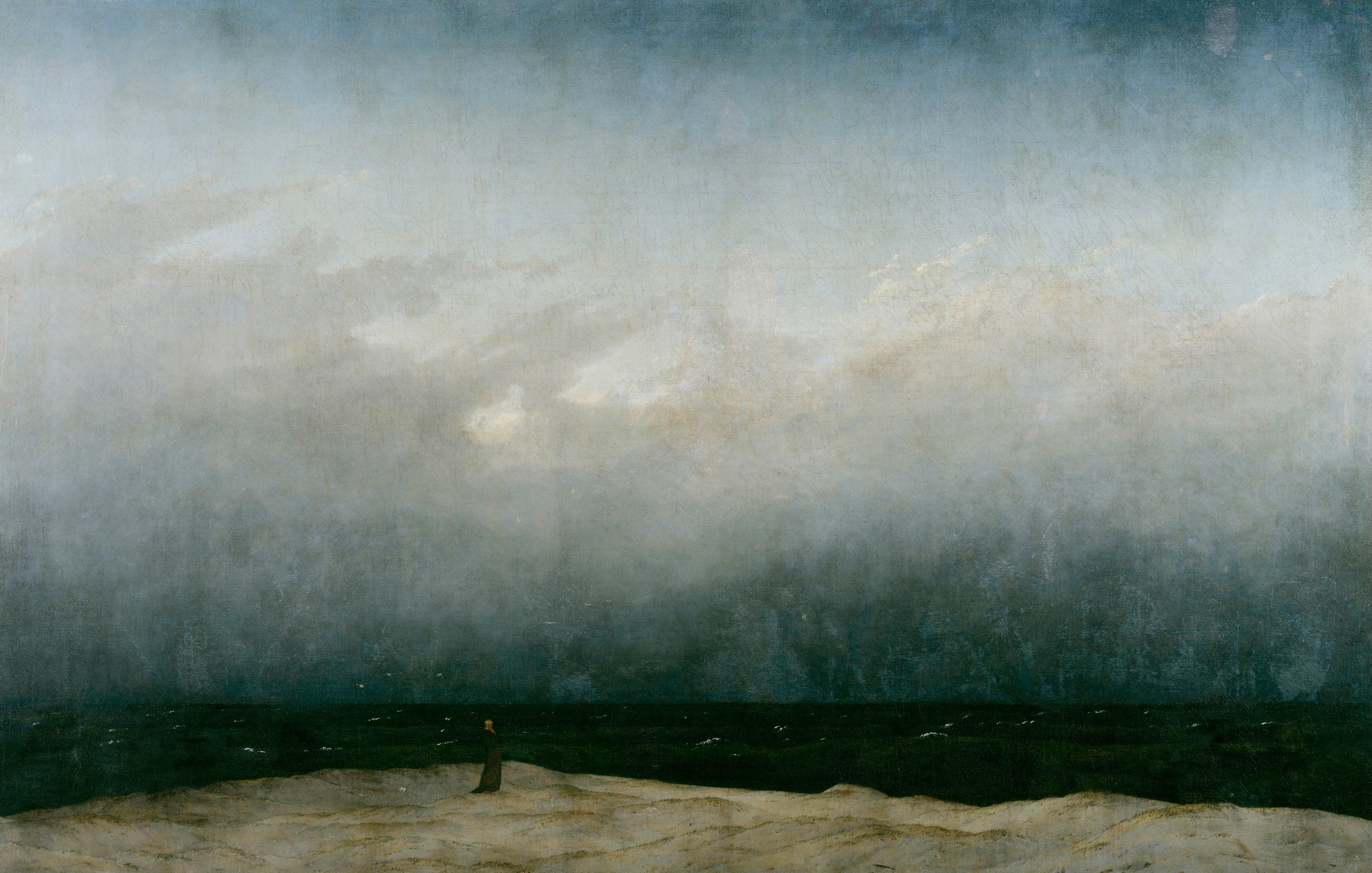
i. quiet arrivals
October unravels gently. The air cools, the light shifts- changes you don’t track until they’re already here. Leaves don’t drift so much as drop. Deliberate, unhurried, final.
Life moves like that: slow cycles of holding on and releasing. I’ve been thinking about this as I prepare to leave Minneapolis. Departures force a certain introspection. How should one think about endings? We imagine we’ll know, graduations, one last hug at the airport, but most endings are sunsets. One minute, the world is golden; the next, you’re standing in the dark, wondering how it happened so quickly.
Yesterday, I watched a leaf fall—slow, certain. I wondered if it knew that morning would be its last connected to its tree. There’s something unsettling in how many goodbyes slip by in the most ordinary of moments. How often do we stand at the precipice of an ending, unaware? The last time you opened up to each other, the last shared laugh, the final quiet drive, the last photo together. Moments rarely register as important until you're looking back, searching for the precise second it all changed.
There’s no perfect English word for it, but 物の哀れ mono no aware—the pathos of things, captures something close. It’s the awareness of fragility, not with despair but reverence. Understanding that their impermanence is what imbues them with meaning. It sits with you like an old friend, reminding you to stay present, not because you can hold the moment, but because you can’t.
I’ve been thinking about this a lot lately, especially with people. There are people whom I’ve already seen for the last time, and I didn’t know it. I think about that a lot. Their faces, voices, little quirks that I loved about them, all now just memory. It’s on my mind as I approach these last ten weeks. Time isn’t distant anymore; it’s compressing, running out. I want to be intentional, to make each hour fuller, more deliberate, as if that might help them last longer.
But I know how this works: soon enough, it’ll be October 2026, and I’ll be looking back at this, wondering if I did enough, or if they blurred past me in the usual way.
Maybe I should freeze this moment. I’ll take a photo, a small token for my future self, sitting here, thinking about this.
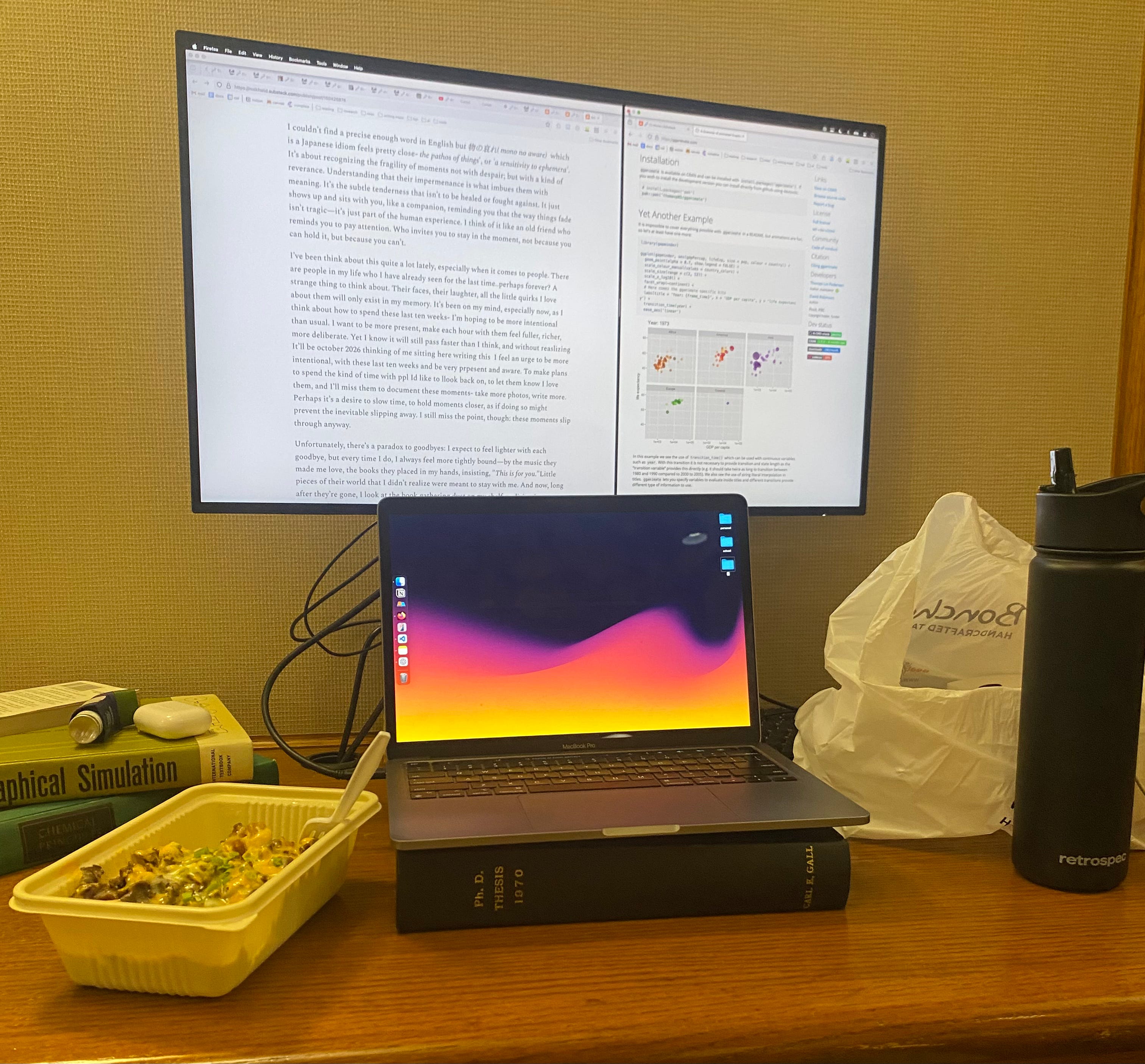
As I was saying, I want to do better. Make time for people, not just in passing, but something deliberate. I want to look back and think, Glad we did that. I didn’t let things slip by. I want them to know I love them. Capture these days, photos, writing, not as if it could stop time, but as a way to hold it, even briefly.
There is a strange physics to goodbyes. You imagine they will create distance, a clean severance, but what actually happens is the opposite—a sudden intensification of gravity around certain objects. The album they made you listen to on that drive. The book they pressed into your hands.
I used to think of gift-giving as transactional. You give me a book, I say thank you, I read it or I don’t.
What’s actually happening is closer to what programmers call “dependency injection”… a pointer to their interiority. The book is an interface. A way of saying: if you want to understand how I process the world, how I feel about beauty and time and loss, start here. Run this program. Watch what it does to your thoughts.
The book sits there. Months pass. You don’t touch it.
Then one day, often much later, after they’re gone or the friendship has dissolved into annual texts, you pick it up. And you realize: this was encoding. They were trying to transmit something they had no direct language for.
Because here’s the thing about the most important parts of yourself: they don’t compress well into conversation. You can’t just tell someone why Sebald restructured your relationship to memory, or why that specific Bill Evans recording makes you understand something about restraint that you can’t articulate. The explanation flattens it. Kills it.
So instead you do this: you hand over the artifact itself. You create conditions for someone else to have the experience. You say, implicitly: meet me here, in this third space, and maybe you’ll understand what I mean when I go quiet at dinner.
This is what’s happening with this sort of transmission, planting seeds that might bloom years later into sudden recognition.
The book on your shelf waits, it knows that one day soon, you’ll pull it down and think, oh. OH. This is what they were trying to tell me.
And in that moment they’re briefly alive again in your nervous system. You’re running their code. Seeing through their eyes. The goodbye wasn’t final after all…they embedded themselves in objects that would ambush you with meaning later.
This is as close to time travel as I’ve managed to get.
So what do I mean when I talk about living on?
The fact that you haven’t listened to that playlist yet, or opened that book they gave you, doesn’t mean they’ve slipped away. Each of those are dormant nodes in a network of memory that pulses with potential. And when you finally reach for them, by curiosity or by need, they’ll unfold like a door opening to a room you haven’t been in for years, but somehow recognize instantly, it’s like time itself bends, pulling that person back into your world for a moment.
The more nodes you create, the more objects you encode with meaning, the more memories you anchor in other people’s experience, the more conversational patterns you establish, the higher the probability that some version of you gets pulled into the future. And it won’t be a total reconstruction, it’ll be small fragments of you, that get called up whenever needed. Invoked. Referenced.
You exist as a living thought, still altering trajectories, nudging decisions in directions they wouldn’t have gone without you.
You’re being used, which I think is better than being remembered.
Do you ever pause to wonder if a moment is the last time you’ll experience something?

ii: objects in motion
I spent most of my childhood moving between Australia, Africa, Europe, and North America. For a while, I thought the transit was just physical, airports, boarding schools, new houses, new streets. Each relocation forced a different version of myself, and I obliged without questioning whether this was sustainable.
The adaptation felt effortless. I learned to read social contexts quickly, to mirror speech patterns, to understand unstated rules. This seemed like a superpower. Look at me, I thought. I can thrive anywhere. How free from the constraints that bind others to a single place, a single identity. Reinvention felt like magic.
That adaptability bonded me with other kids who had lived through the same pattern. We recognized each other instinctively…the international school kids, the other children with stories too long for icebreakers. There was a quiet pride in that rootlessness. When adults asked, And where are you from? we’d glance at each other, half-smiling, eyebrows raised, like conspirators in a shared secret. We knew the question was too small for the answer.
We had options: the short version, or the long one. I always liked the times I felt comfortable sharing the long one. I liked how their curiosity stretched out, how they watched me assemble my past in pieces, city by city, as if trying to solve a puzzle. It felt warm, that attention. But now I wonder if that warmth was just the brief comfort of being legible…if only for a moment.
But later, cracks appeared in the story. The adaptability I had treated as strength began to feel like something else entirely. The ability to leave isn’t a skill; it’s a reflex. And like any reflex, it can become destructive, automatic. What if all that supposed resilience wasn’t really resilience at all? What if it was just a more polished form of detachment? A clever way of never staying long enough to belong, or worse, to lose something.
And that raises a harder question: how much of my adaptability is just a way of avoiding attachment? The knowing glance, the easy answer, it was a trick, but also a shield. Maybe we weren’t being clever when we left our answers unfinished. Maybe we didn’t know anymore. Maybe the real answer was something like, I’m from wherever I’m not standing.
Every move left something behind. People, yes, but also entire versions of myself, selves that only existed in those contexts, with those people. It’s strange to think about. Not just that I’ve left others behind, but that I’ve left behind fragments of who I was. Versions that were never quite portable.
For years, I believed home was something I could rebuild every time I landed somewhere new. But now I wonder if home isn’t a place at all. Maybe home is just the rare, fleeting moment when the scattered pieces of you feel like they fit together again. When all those selves align…if only for a second.
The question I’m left with isn’t whether this kind of life is good or bad. It’s simpler: What does it cost to become good at leaving?
iii: folding and unfolding
"Movement is nothing more than the endless process of folding and unfolding."
— M.O., February 16, 2023
There will be a last goodbye. This is mathematically certain. But it won’t announce itself. No soundtrack, no slow-motion cinematography. It will arrive disguised as an ordinary moment—Tuesday afternoon, distracted by email, running late for something forgettable. Only later will you realize something ended.
We expect life to mark its important moments clearly, like chapters in a book. But life has no narrator. It just unfolds, indifferent to whether we’re paying attention.
For years this seemed tragic. We’re constantly losing things without noticing. The last time you carried your child before they became too heavy. The last conversation with someone who used to be essential. These moments dissolve into the ordinary precisely because they don’t know they’re endings.
Tragedy isn’t the right frame here.
In The Order of Time, the physicist Carlo Rovelli dismantles our intuitive picture of how time works. Time, he shows, isn’t a universal river carrying everyone forward at the same rate. It’s local, variable, dependent on where you stand and how fast you’re moving. Near a massive object, time slows. At high velocity, it dilates. Two events that appear simultaneous from one vantage point occur in sequence from another.
What makes Rovelli’s account interesting for understanding goodbyes is what it suggests about persistence. In classical physics, objects endure through time like beads on a string—the same thing, moment after moment, moving forward. But in Rovelli’s picture, what we call an object is really a process: a pattern of interactions, continuously exchanging energy and information with everything around it. Nothing is isolated. Nothing stays the same.
Time moves forward without asking for permission, indifferent to whether we’re ready to follow. It doesn’t just take from us; it spreads us outward, distributes us into the future in ways we’ll never fully understand. Every conversation, every decision becomes a ripple—a pulse of causality that keeps unfolding long after we’re gone.
The thought is strangely comforting. What I am…what we are, continues in fragments, scattered across the lives of others. Nothing is truly lost; it’s simply transformed. The moments we shared break apart and reassemble into something new, appearing in places we’ll never see.
Impermanence holds its own beauty. We don’t need much to feel whole—just a bit of awareness, a little presence. There’s a kind of holiness in small things. The crisp air of an early morning. The way sunlight pools on your kitchen floor. Or the lift in your chest when an old favorite song fills a café, and you realize the person next to you is humming along. You wonder what memory the song stirs in them, but maybe that’s the beauty: it doesn’t matter. For a fleeting moment, you share something—an invisible thread of recognition. A reminder that we are here, and we are alive.
Goodbyes are misunderstood. We like to frame them as endings, sharp delineations between one chapter and the next. As if the self can be cut cleanly from its context and stored away, like old photographs in a box. But time doesn’t work like that, and neither do we. There is no sharp edge, no clean break. The story continues without us. The people we love will move on, but that’s not a sad thing. That’s what life does—it moves. It carries everything forward, reshaping what we thought we’d left behind.,
That’s the real work of saying goodbye: trusting in what’s already been shared. Trusting that it’s enough. Trusting that the threads will hold, even if you never see where they go. What you gave to each other will unfold slowly, quietly, in ways you’ll never fully understand. The people you love will remain with you—not as memories filed neatly away, but as something woven into the fabric of who you are, who you’ll become.
And maybe that’s the only kind of closure we ever get. An unfolding: a slow, subtle recursion of everything we’ve ever been into everything we’ll ever be.
Nothing is truly lost. It just changes form, like an Echo, fainter each time, but still there, still part of us.
And that, I think, is enough.
Thank you for reading. Writing them was less about arriving at answers and more about marking where I’ve been. If something here found you, even briefly, then it did its job.
And finally to you, who taught me the most meaningful things often return quietly, long after we think they’ve disappeared: this whole piece is really just an elaborate way of saying thank you.
See you out there.
-K.
I’ll leave you with a song that’s been living in my head lately. It feels like everything this piece tried to say but couldn’t quite find the words for. I’m hesitant to prescribe listening experiences…music works through association, and yours will be different from mine.
Maybe it will mean something to you too, or maybe it will just keep you company for a few minutes. Either way, thank you for walking with me through these thoughts.
Beautiful piece!
Some thoughts below,
“When was the last time you felt something you didn’t want to end too soon?”
Today honestly. I reached out to a very close friend where the relationship got complicated in an attempt to mend it. Maybe I haven’t learned to accept goodbye as you have but I think it’s premature right now.
“Maybe we don’t need to cling to permanence, to the idea that we have to hold on to every experience forever. Maybe the awareness that it’s all fleeting is what makes it meaningful.”
This is my mental picture of “its never that deep”
all goodbyes are dispersals, but some can be dispersed more than others, what type of goodbyes do you believe are the best?
I came here from your writing about travel and how traveling into the unknown changes you more than staying in the comfortable.
Just before I had read that piece, I was drawing the northern lights in colored pencils, and then I came into my studio, and I had started tracing a photo from when I was 16, wearing converse and that same red butterfly was on my converse shoes! The universe works in mysterious ways
Planting seeds of connections woven into the life and love we live on our journeys here